01
Coastal AI & digital twins
Physics-informed learning, probabilistic surrogates, data assimilation, and fast emulators for coastal water levels and flooding.
I develop computational and AI-enabled approaches at the coast–AI interface, including physics-informed machine learning and probabilistic emulation, for compound flooding, tropical-cyclone hazards, coastal water levels, and climate extremes, connecting physical understanding with fast, decision-relevant climate-risk modeling.

Selected honors, leadership roles, professional service, and research achievements across coastal and ocean engineering.
Experience securing and developing externally funded proposals for NSF, NOAA, and DOE calls.
Co-author of Chapter 5 of the ASCE manual on compound flooding.
National recognitions for academic excellence in Ocean Engineering.
Appointed member of the ASCE Task Committee on Compound Flooding.
Lead guest editor for Advances in Water Resources and primary chair of AGU Coastal Hydrology sessions.
My work spans physical modeling, machine learning, uncertainty, and risk. The common thread is making complex coastal-hazard information more predictive, computationally efficient, and usable.
Physics-informed learning, probabilistic surrogates, data assimilation, and fast emulators for coastal water levels and flooding.
Interactions among storm surge, rainfall, tides, river discharge, and infrastructure in multi-driver flood systems.
Rapid intensification, marine heatwaves, destructive potential, and climate-sensitive coastal hazard behavior.
Probabilistic design, nonstationary extremes, hazard communication, nature-based solutions, and decision support.
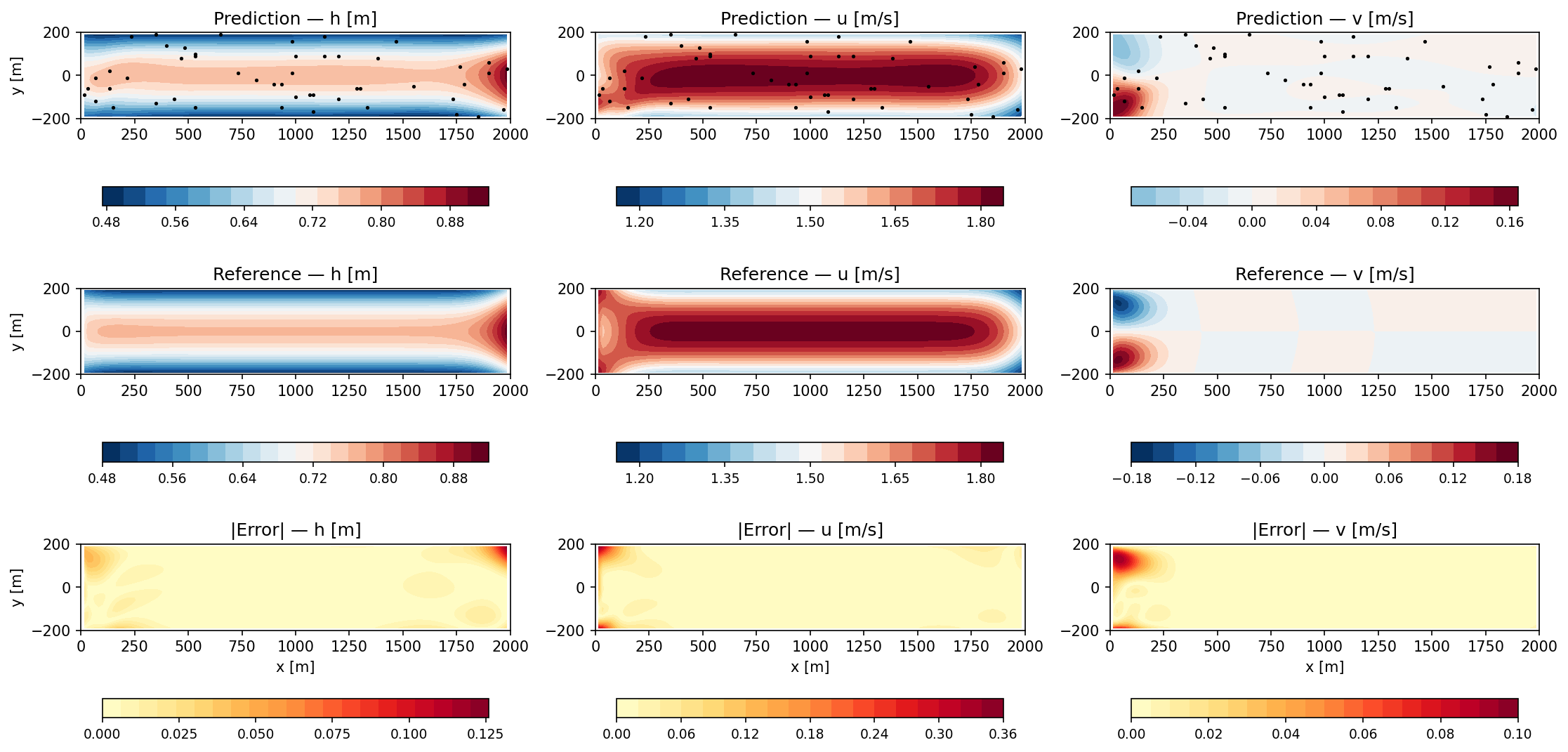
A systematic 1D/2D shallow-water benchmark tests when inverse physics-informed neural networks can recover Manning’s roughness from sparse and noisy observations, and how parameter recovery depends on the observed variables.
Read the paper → HESS · 2026
A systematic framework distinguishing sequential, feedback, and ensemble structures for combining statistical and physics-based models.
 Science Advances · 2026
Global analysis of how marine heatwaves and rapid intensification can act synergistically to amplify tropical-cyclone destructive potential.
 GC · 2025
The Angles method uses geometric relationships to communicate nonstationary dependence among flood drivers to technical and broader audiences.
Work on tropical-cyclone rapid intensification and coastal hazards has reached research, practitioner, and public audiences through interdisciplinary collaboration and media communication.
I’m based in the Department of Civil and Environmental Engineering at Princeton University. For research collaborations, talks, and academic inquiries, email is the most direct route.